
Executive Summary
Jewellery repair is a high-trust, high-liability service. When a customer hands over their grandmother's antique 22k gold necklace for a clasp repair or polishing, they are trusting the store with a precious, irreplaceable asset. Unfortunately, the traditional methods used to manage these repairs—carbon-copy slips, handwritten weights, and disjointed phone calls to off-site artisans—are a recipe for chaos.
Misplaced slips lead to forgotten orders. Undocumented intake weights lead to customer disputes over "stolen" gold. Untracked artisans lead to blown deadlines and furious clients.
This case study explores how DiamondOar, the industry's premier Jewellery ERP Software, brings absolute transparency and efficiency to the repair process. By digitizing intake, automating customer communication, and strictly tracking artisan accountability, DiamondOar transforms a liability-laden chore into a profitable, trust-building service.
The Chaos of Traditional Repair Management
To understand why a dedicated Jewellery Repair Tracking Software is essential, we must look at where the traditional process breaks down. The friction points are numerous and severe.
Lost Paper Slips and Ambiguous Descriptions
A customer drops off a ring to be resized. The staff writes "resize ring, 18k, 4g" on a paper slip. Two weeks later, the customer returns. The paper slip is lost. The artisan has three different 18k rings in the workshop and no idea which one belongs to this specific customer. The resulting confusion damages the store's reputation irreparably.
Customer Disputes Over Weight
Polishing, melting, and resizing inherently involve minor losses in gold weight. If the intake weight isn't rigorously documented and agreed upon, a customer might weigh their ring upon return, notice a 0.5-gram discrepancy, and accuse the store of theft. Without digital proof of the original state, the store has no defense.
Untracked Artisan Delays
Most shops send repairs to external goldsmiths or dedicated off-site workshops. When a customer calls asking if their item is ready, the front-desk staff has no visibility. They must put the customer on hold, call the artisan (who may not answer), and relay the message. This breaks down communication and leads to massive delays.
The Traditional Process: High Risk, Low Reward
1. Intake: The item is manually weighed. A brief description is scribbled on a triplicate paper receipt. 2. Transfer: The item is placed in a generic envelope and handed to a courier or artisan. 3. The Black Hole: The store has zero visibility into the repair status. 4. The Chase: The customer calls for an update. Staff scramble to find the physical ledger, then call the artisan. 5. Return & Billing: The artisan returns the item with a handwritten note of their labour charge. The store manually calculates the final markup, writes an invoice, and calls the customer to pick it up.
The DiamondOar Workflow: Digital End-to-End Tracking
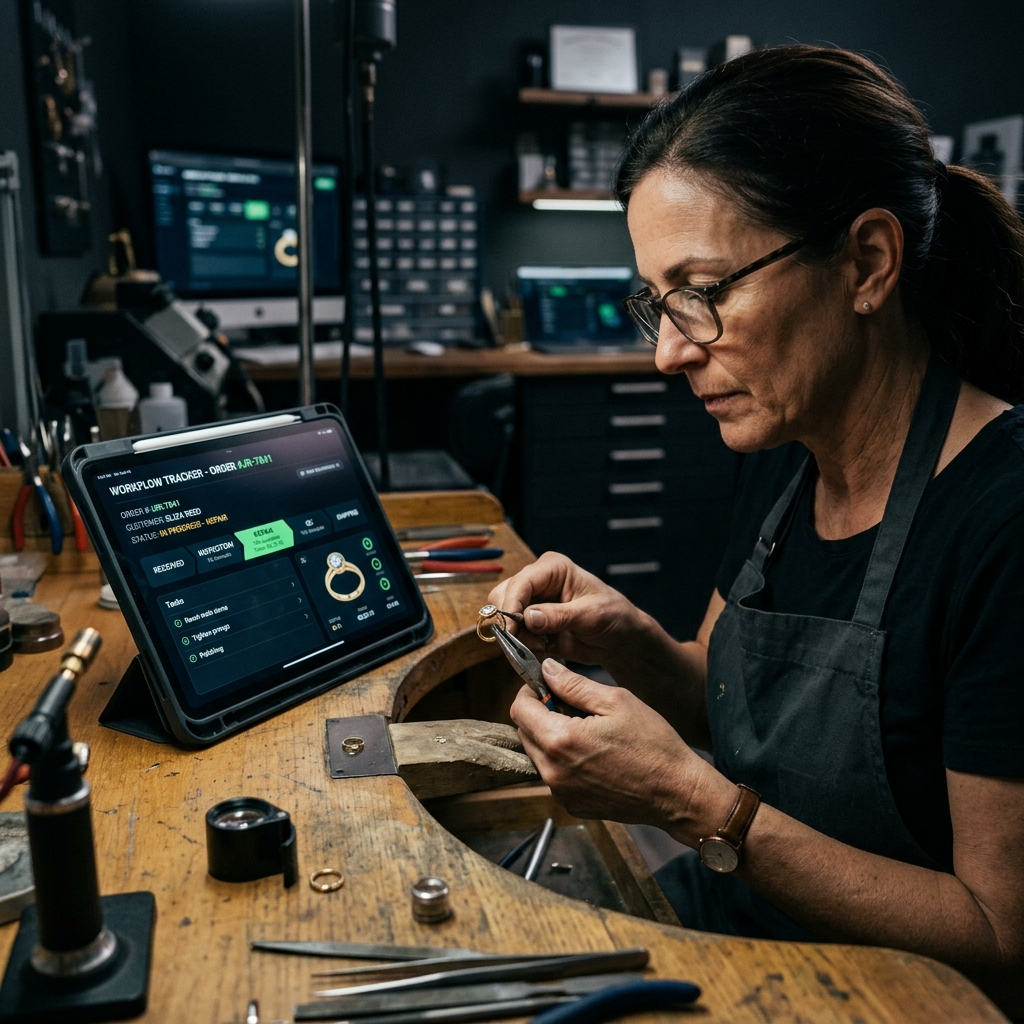
How to track jewellery repairs digitally and securely? DiamondOar eliminates the black hole of the artisan workshop and brings the entire process onto a centralized, transparent dashboard.
Step 1: Digital Intake with Photos & Precise Weight
When the customer hands over the necklace, the staff uses the DiamondOar POS tablet. They place the item on the integrated digital scale, which automatically captures the exact gross weight into the system. The staff takes a high-resolution photo of the necklace using the tablet’s camera. The photo, weight, and detailed repair instructions (e.g., "Replace clasp, polish") are locked into the digital repair order. The customer digitally signs the intake form, acknowledging the starting weight.
Step 2: Artisan Assignment and Transfer
The repair order is digitally assigned to a specific internal or external artisan. A secure, barcode-labelled envelope is generated. When the artisan receives the item, it is scanned into their queue. The store manager can see exactly which artisan holds the item and when it arrived.
Step 3: Automated Customer Updates (WhatsApp/SMS)
As the item moves through the workflow—from "Received by Artisan" to "In Progress" to "Quality Check"—DiamondOar automatically triggers WhatsApp or SMS updates to the customer. The customer never has to call the store for an update; they are kept perfectly in the loop.
Step 4: Final Costing and Return
When the artisan completes the job, they log their exact labour charge and the final weight into the system. DiamondOar automatically applies the store’s predefined markup rules to generate the final customer price. When the customer arrives, the item is weighed again on the digital scale, proving the exact weight difference. The invoice is generated with one click, and the transaction is closed securely.
Customer Experience Comparison
| Feature | Traditional Management | DiamondOar ERP |
|---|---|---|
| **Intake Proof** | Vague handwritten slip | **High-res photos & digital signature** |
| **Status Updates** | Customer must call and wait | **Automated WhatsApp/SMS alerts** |
| **Weight Transparency** | Word-of-mouth disputes | **Digitally logged before/after weights** |
| **Artisan Tracking** | Unknown ("It's at the workshop") | **Live dashboard status tracking** |
Business Benefits of Digital Repair Management
Implementing a Goldsmith Management Software like DiamondOar does more than just organize the workbench; it actively protects the business.
1. Zero Liability Disputes
Because every item is photographed and its weight is digitally logged and signed for at intake, "he said, she said" disputes over missing stones or lost gold weight are entirely eliminated. The store is legally and operationally protected.
2. Faster Turnaround Times
When artisans know their completion times are being tracked on a central dashboard, efficiency skyrockets. Managers can easily see which goldsmith is a bottleneck and reassign work accordingly.
3. Transparent Artisan Billing
Stores no longer have to decipher handwritten artisan invoices at the end of the month. Every repair's labour charge is logged digitally in DiamondOar, making end-of-month artisan payouts perfectly accurate and instantly reconcilable.
4. Effortless Customer Service
By automating status updates via WhatsApp, the front-desk staff is freed from answering dozens of "Is my ring ready yet?" phone calls every day. They can focus on selling, while the software handles the communication.
Real-World Example: The Antique Necklace Restoration
A customer brings in a 100-year-old family heirloom necklace. The clasp is broken, and several stones are loose. She is incredibly anxious about leaving it.
In a traditional shop, she is handed a flimsy pink piece of paper with a handwritten scribble. She leaves feeling nervous and calls the shop three times over the next two weeks for updates, growing increasingly frustrated when the staff can't give her a straight answer.
In a shop powered by DiamondOar, the experience is luxurious and reassuring. The staff takes three macro photos of the necklace, highlighting the loose stones. The exact weight is recorded digitally. The customer receives a WhatsApp confirmation instantly with the photos attached. Three days later, she gets an automated text: "Your necklace has safely arrived at our master goldsmith." Five days later: "The clasp has been replaced and polishing is complete. Your item is undergoing Quality Assurance." She picks up the item, the final weight is verified against the intake photo, and she pays the automated invoice. The transparency builds immense trust, ensuring she will return for her next major purchase.
Conclusion
Jewellery repair is a fantastic way to build lifelong customer loyalty—but only if the process is handled with absolute professionalism. Relying on paper slips and memory to manage precious family heirlooms is a risk that modern businesses cannot afford.
By upgrading to DiamondOar’s specialized Jewellery Customer Service Software, owners protect themselves from liability, drastically improve their turnaround times, and provide a world-class, transparent experience that their customers will love.
Bring Transparency to Your Workbench
Stop losing repair slips and fighting over intake weights.